Essential Planting Aids for Successful Deer Food Plots

Last Updated: November 8, 2026
Quick Summary
The essential planting aids for successful deer food plots are matched to plot size: hand spreaders, backpack sprayers and rakes under 1 acre, ATV/UTV spreaders and pull-behind sprayers for 1 to 5 acres, and tractor spreaders, seed drills and boom sprayers above 5 acres. Calibrate every spreader before planting so seed, lime and fertilizer go out at the target rate.
- A hand-crank broadcast spreader handles seed and fertilizer on plots under an acre without fuel cost.
- Above 5 acres, a three-point spreader, seed drill and boom sprayer let you plant, spray and fertilize at scale.
- Calibrate by running a measured 100-foot strip, weighing what's left and adjusting the gate until the rate matches your target.
- Lime is far denser than seed, so calibrate separately for every material and clean the hopper between materials.
- No-till food plots skip the plow and plant directly into existing cover or a sprayed-down thatch layer.
Table of Contents
- Matching Food Plot Planting Tools to Your Acreage and Terrain
- No-Till Food Plots for Deer: Less Disturbance, Better Moisture
- When to Plant Food Plots for Deer by Season and Region
- The Best Food Plot for Deer in Fall: Species and Timing
- Calibrating Spreaders and Calculating Seed, Lime, and Fertilizer
- Choosing Your Planting Aids and Seed from Morse Nursery
- Frequently Asked Questions
Matching Food Plot Planting Tools to Your Acreage and Terrain
The right essential planting aids for successful deer food plots start with one honest question: how big is the ground you're planting, and what can you get onto it? Once plot size and access set the limits, planting accessories can help fill the gaps between what your equipment handles and what the ground still needs.
Here's the short version before we break it down:
| Plot Size | Primary Tools | Typical Budget |
|---|---|---|
| Under 1 acre | Hand spreader, backpack sprayer, rake | Lowest |
| 1 to 5 acres | ATV/UTV spreader, pull-behind sprayer | Mid-range |
| 5+ acres | Tractor spreader, seed drill, boom sprayer | Highest |
Small Plots and Hand Tools
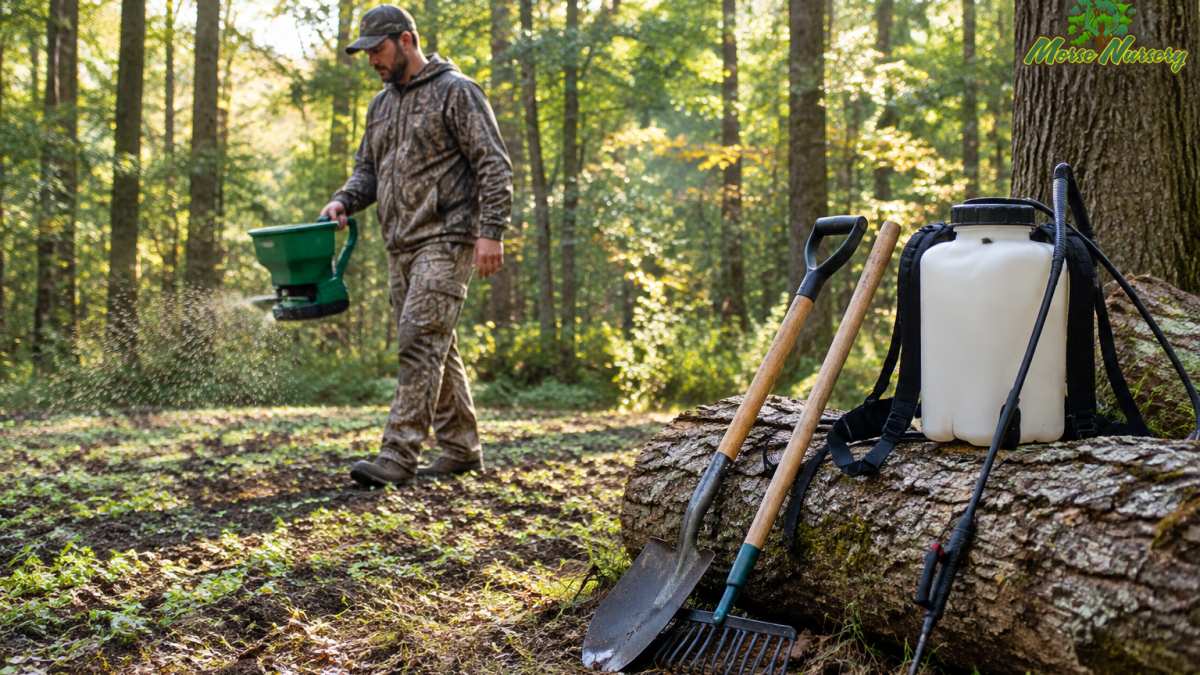
Small plots reward simple tools. A hand-crank broadcast spreader handles seed and fertilizer on plots under an acre without any fuel cost.
The trade-off is time. Hand seeding a half-acre takes patience and a steady crank speed for even coverage. Plan your passes and refill points before you start, since refilling can become the bottleneck on larger hand-seeded areas.
Watch out: A hand spreader's gate opening is set for a specific seed size. If you switch from small clover to large soybeans without adjusting the gate, you'll either starve the flow or dump seed in clumps.
Mid-Size Plots and ATV Equipment
An ATV or UTV changes the math on 1 to 5 acres. A pull-behind broadcast spreader covers ground fast, and an ATV-mounted sprayer handles herbicide and liquid fertilizer without hauling a tank on your back.
What most guides miss is the hitch. Make sure your spreader's gate settings match the seed size you're throwing, or you'll get streaks and bare patches.
Access matters as much as acreage here. If your plot sits behind a gate narrower than your ATV, or the trail in is too steep or muddy for a loaded trailer, the machine becomes a liability.
Large Plots and Tractor Implements
Above 5 acres, a tractor stops being a luxury. A three-point spreader, a seed drill, and a boom sprayer let you plant, spray, and fertilize at scale. A drill places seed at consistent depth, which matters more than most people realize for germination.
A drill also lets you plant into heavier residue than a broadcast spreader can handle. The trade-off is cost and setup: a drill is a significant investment, and it needs calibration just like a spreader.
Matching the Tool to the Task, Not Just the Acreage
Acreage sets the scale, but the task sets the tool. Use this checklist to sort what you actually need:
- Weed control before planting: backpack sprayer for small plots, ATV or boom sprayer for larger ground
- Seedbed prep: rake or hand tools on small plots, a disc or tiller behind an ATV or tractor on larger ones
- Seeding: hand spreader under an acre, pull-behind spreader for 1 to 5 acres, drill or three-point spreader above 5 acres
- Fertilizing: the same spreader you use for seed, provided you clean it between materials
- Lime: a spreader rated for the volume, since lime is heavy and abrasive
If you're weighing hand tools against machine options, browse our planting products to see what fits your acreage.
No-Till Food Plots for Deer: Less Disturbance, Better Moisture
No-till food plots for deer skip the plow and plant directly into existing ground cover or a sprayed-down thatch layer. The payoff is real: less soil disturbance means better moisture retention, fewer weed seeds turned up, and less erosion on sloped ground.
The catch is that no-till leans on herbicide to clear competition before planting. Plan your spray timing around rainfall, and don't plant into green, growing weeds.
For landowners building long-term structure into a plot, proven tree options pair well with no-till annuals. Our guide to the best trees for deer food plots covers five reliable choices to build around.
When to Plant Food Plots for Deer by Season and Region
Timing drives everything. Planting too early or too late can cost you the stand.
A practical month-by-month view:
- Late winter to early spring: Frost seed clover on frozen ground
- Spring: Plant warm-season annuals like soybeans and corn after soil warms
- Late summer: Brassicas and cereal grains go in for fall and winter forage
- Early fall: Cereal grains and clover for a fast-establishing plot
Regional climate shifts these windows. Northern properties plant earlier in fall; southern properties can stretch later.
The Best Food Plot for Deer in Fall: Species and Timing
The best food plot for deer in fall combines fast-establishing cereal grains with brassicas and a clover base. Cereal grains like oats and wheat germinate quickly and hold deer through early season. Brassicas sweeten after frost and carry nutrition into winter.
Clover earns its place as an understory. Our Charlie's Clover is a six-clover perennial blend built for orchards and tree plots, fixing nitrogen and providing forage that can persist for three to five years with proper maintenance.
Once you've picked your species, shop our food plot seed collection to get it in the ground.
Calibrating Spreaders and Calculating Seed, Lime, and Fertilizer
Calibration is where good plots separate from mediocre ones. A spreader throwing too heavy wastes seed and money; too light leaves thin, patchy stands. The goal is simple: know exactly how much material leaves the hopper per pass, then adjust until that number matches your target rate.
Here's a simple calibration routine that works for hand, pull-behind, and three-point spreaders:
- Fill the hopper with a known weight of seed
- Mark a measured strip, say 100 feet long
- Run the spreader at your normal pace and gate setting
- Weigh what's left and calculate your actual rate
- Adjust the gate and repeat until the rate matches your target
A Worked Example
Suppose you want to apply 100 pounds of seed per acre and your spreader throws a 10-foot swath. A 100-foot pass covers 1,000 square feet, or about 0.023 of an acre. At 100 pounds per acre, that pass should drop roughly 2.3 pounds of seed. Weigh the hopper before and after the pass; if you dropped 4 pounds, your gate is too wide and you're applying nearly double the target rate.
Expect to make a few test passes to dial in a new seed size. Write the gate setting and ground speed on a tag and keep it with the spreader so you don't have to recalibrate every season.
Converting Soil-Test Recommendations into Hopper Settings
For lime and fertilizer, start with a soil test (Lab Services - Soil and Water Testing). It tells you exactly how much to apply instead of guessing.
Watch out: Lime is far denser than seed, so a gate setting that works for clover will starve a lime application. Calibrate separately for every material you spread, and clean the hopper between materials so leftover seed doesn't contaminate the next pass.
Once your rates are set, follow the Morse Seed planting instructions to apply them correctly.
Choosing Your Planting Aids and Seed from Morse Nursery
We built Morse Nursery around one idea: genetics and preparation decide whether a plot pays off.
Our planting aids round out the toolkit. Nutra Pro slow-release fertilizer feeds young trees at the root zone. BioRush Plus 3-0-11 supports root development and soil biology. Soft Soil loosens compacted ground so roots and water move freely.
If you're adding pears to your plan, our guide on choosing self-fertile pear trees helps you pick varieties that pollinate reliably.
Getting a food plot to produce takes the right tools, the right timing, and genetics that actually perform.
Frequently Asked Questions
What tools do you need to plant a deer food plot?
A basic set includes a soil test kit, a backpack sprayer for weed control, a broadcast spreader for seed and fertilizer, and a rake or drag for covering seed. For larger plots, add an ATV or tractor with a disc or no-till drill. Calibrate your spreader before planting to avoid uneven stands. Morse Nursery offers planting aids like Nutra Pro fertilizer packs and Charlie's Clover seed to support establishment.
Can you plant a deer food plot without a tractor?
Yes. Many successful plots are planted with hand tools or ATV-mounted equipment. For plots under an acre, a backpack sprayer, hand-crank spreader, and rake can handle site preparation and seeding. No-till methods work well with a backpack sprayer and a spreader, especially when using clover or cereal grains. Focus on proper soil pH and seed-to-soil contact rather than equipment size.
When should you plant a food plot for deer?
Timing depends on the species and your region. Cool-season plots like clover and cereal grains are typically planted in early fall, about 45 to 60 days before the first frost. Warm-season plots like soybeans and corn go in during late spring. In the South, fall planting can extend later. Check local frost dates and aim for adequate rainfall during establishment.
How do you prepare soil for a successful deer food plot?
Start with a soil test to check pH and nutrient levels. Most food plots need a pH between 6.0 and 7.0; apply lime if it is low. Control existing weeds with herbicide or mechanical removal before planting. For no-till plots, spray and then broadcast seed without disturbing the soil. Ensure good seed-to-soil contact and use a slow-release fertilizer like Nutra Pro for young trees and shrubs.