Best Trees for Deer Food Plots: 5 Proven Options to Build Your Plot Around

Table of Contents
- Quick Comparison: 5 Deer Food Plot Trees at a Glance
- 1. November Hybrid American Chestnuts: The Late-Season Anchor
- 2. American Persimmons: Late Drop Buffet
- 3. Kieffer Pear: Heavy Production, Easy Maintenance, and Excellent Deer Attraction
- 4. Nova Scotia Crabapple: Heavy Fruit and Strong Disease Resistance
- 5. Liberty Apple: The October Drop for Bow Season
- How to Stagger Fruit Drop Times for Deer Across Your Property
- Pollination Requirements for Wildlife Trees: What You Need to Know
- Frequently Asked Questions
Last Updated: October 21, 2026
Quick Comparison: 5 Deer Food Plot Trees at a Glance
The best trees for deer food plots drop mast when deer need it most, so match species to your zone, soil, and season. Morse Nursery has spent more than 40 years selecting fruit and nut trees for this job, and these five are the ones we would build a plot around.
Here is the short version before the detail:
Tree |
Drop Window |
Zones |
Best For |
Starting Price |
|---|---|---|---|---|
November Hybrid Chestnut |
November |
4-8 |
Late-season anchor |
$35.00 |
October and November |
4-9 |
Sweet soft mast |
$40 |
|
Late October to early December |
3-8 |
Low-maintenance reliability |
$30.00 |
|
Late Drop, heavy annual set |
4-8 |
Disease resistance |
$25-30 |
|
October |
4-8 |
Bow season attraction |
$30 |
One correction up front: you do not need all five. Pick the one that fits your goals and fills the biggest gap in your property's food calendar, then add earlier and later dropping varieties around it.

1. November Hybrid American Chestnuts: The Late-Season Anchor
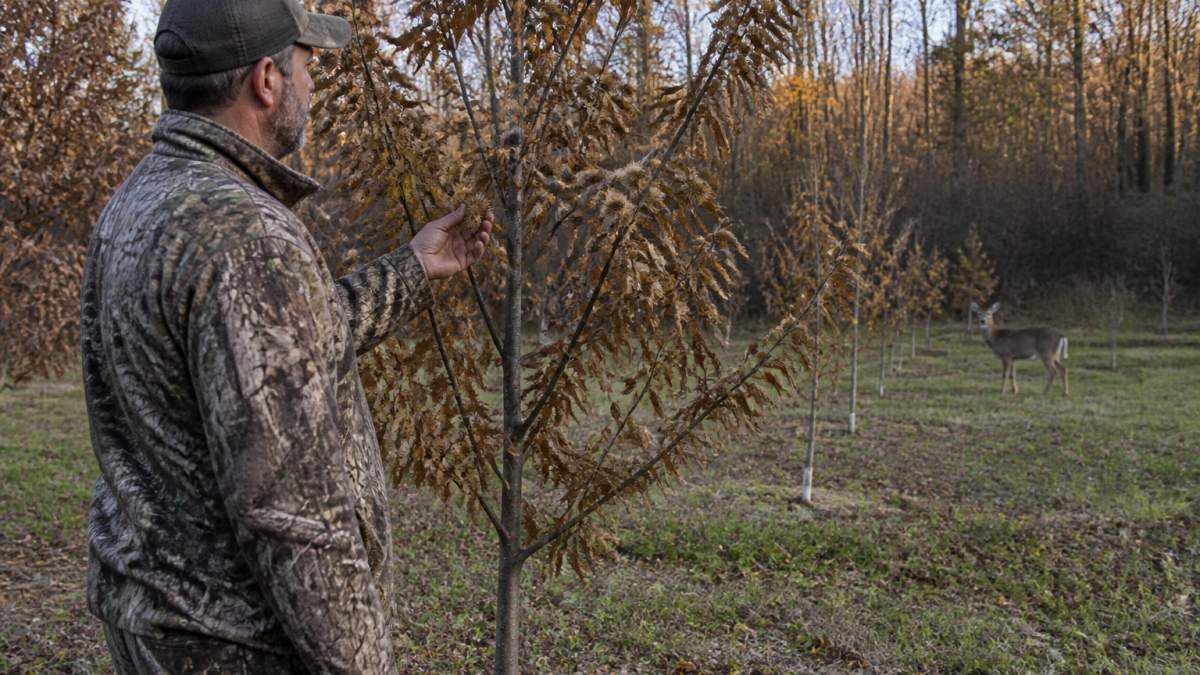
Chestnuts are the most reliable late-season hard mast you can plant, and November-dropping hybrids are the backbone of a serious deer orchard.
Planting and Pollination Notes for Chestnuts
Full sun, well-drained soil, and 20 to 35 feet between trees. Chestnuts tolerate sandy and loamy ground but suffer in standing water. Tube the trunk against browse and buck rub, and water through dry spells in years one and two.
2. American Persimmons: Late Drop Buffet
Persimmons earned the name Deer Magnet and Deer Candy: ripe fruit is high in sugar and deer seek it out over almost anything else. American persimmons drop from October into December, filling the gap between early chestnuts and late pears.
Why Persimmons Fill a Gap Nothing Else Does
Persimmons are dioecious as a species, meaning most named varieties need a male tree nearby to set fruit, which is why self-fruiting types are worth the extra attention.
Astringency matters too. Unripe persimmons are mouth-puckeringly tannic and deer leave them alone; fruit becomes palatable only as it softens and sugars develop. That is why drop timing, not just fruit set, is the trait to select for.
Site Selection, Spacing, and Time to Fruit
Persimmons are more forgiving than apples or pears on poor ground, but they still have requirements:
- Sun: Full sun for heavy fruit set; shaded trees flower poorly and drop fruit early.
- Soil: Well-drained loam to clay loam. Persimmons tolerate occasional wet feet better than most fruit trees but will not thrive in standing water.
- Spacing: 20 to 30 feet between trees to accommodate mature spread.
- Hardiness: American persimmons are generally rated for zones 5 through 9, so confirm your zone before ordering. Some varieties can live in Zone 4.
Protection and Early Care
Young persimmons are browse magnets, deer nip new growth and bucks rub saplings. Use a Tree tube for the first several years and a weed mat to cut competition, and watch out for dry spells in the first two years to make sure the soil is moist.
For a supporting option, Morse Persimmon and September Drop Persimmon extend the window earlier into the season, giving you an October-to-November persimmon block rather than a single tree.
3. Kieffer Pear: Heavy Production, Easy Maintenance, and Excellent Deer Attraction
If you're looking for a dependable, heavy-producing fruit tree to build your deer plot around, Kieffer Pear is hard to beat. Known for its vigorous growth, adaptability, and consistent fruit production, Kieffer is an excellent choice for landowners who want maximum wildlife benefit with minimal maintenance.
One of its biggest advantages is that it's self-fertile, meaning it can produce pears without another variety nearby. Its late-season fruit availability makes it especially valuable during the rut and into the colder months.
For an even more productive pear plot, surround Kieffer with supporting varieties like Morse's Hybrid Pear, Baldwin, and Seckel to diversify your orchard and extend food availability.
Our recommendation: Make Kieffer Pear the foundation of your pear plot. Its reliable crops, easy maintenance, and late-season attraction make it one of our favorite pears for whitetail habitat.
4. Nova Scotia Crabapple: Heavy Fruit and Strong Disease Resistance
Crabapples are the most underrated deer food plot trees on the market. Nova Scotia produces large, sweet fruit in heavy annual crops, and its disease resistance separates it from fussier apples that spot and drop early.
What 'Disease Resistance' Actually Means
The better crabapple selections carry meaningful resistance to the diseases that ruin apple crops: apple scab, cedar apple rust, fire blight, and powdery mildew. Resistance is not immunity, a wet spring can still bring some scab, but a resistant crabapple holds fruit and foliage far better than a dessert apple without a spray program.
The Pollination Bonus
Crabapples are generous pollinators for apples. Their bloom overlaps with most apple varieties and they throw abundant pollen, so a crabapple near your Liberty or Arkansas Black block serves double duty: its own heavy fruit crop plus pollination for the apples around it. Whitney Crabapple is the supporting pick and a dependable pollinator for your apple block.
All Season Apple Bundle - Apples from Aug - November →
Site, Spacing, and Time to Fruit
- Sun: Full sun for heavy annual set; part shade reduces fruit and invites disease.
- Soil: Adaptable and more tolerant of poorer, drier ground than dessert apples, which makes crabapple a smart choice for property edges where you are not running irrigation.
- Spacing: 15 to 20 feet apart.
- Hardiness: Nova Scotia crabapple is generally rated for zones 4 through 8; confirm your zone before ordering.
Where It Fits in the Calendar
Nova Scotia Crabapple is an excellent foundational tree for an apple and crabapple food plot, producing an abundance of large, sweet crabapples that drop from late October through November. This late-season production provides a valuable food source during the rut. Nova Scotia pairs exceptionally well with Liberty and GoldRush apples, creating a productive, disease-resistant orchard with complementary drop times that keeps deer returning throughout hunting season.
Protection and Maintenance
Tube the tree against buck rub and browse for the first few years, and use a weed mat to cut competition. Prune only to remove dead or crossing wood and open the center for light and airflow, which also reduces disease pressure.
5. Liberty Apple: The October Drop for Bow Season
Liberty apple is the disease-resistant workhorse of the deer orchard, carrying strong resistance to apple scab, cedar apple rust, fire blight, and powdery mildew, less spraying and more consistent fruit.
Liberty drops in October, right when bow season is heating up and deer are shifting onto soft mast.
Liberty is not self-fertile, so pair it with a crabapple or another apple variety for pollination.
How to Stagger Fruit Drop Times for Deer Across Your Property
Staggering drop times is the single highest-value move you can make in a deer food plot, and it costs nothing beyond planning.
Build the calendar in layers:
- August to early September: August Drop chestnut, Honey Crips apple, and Zestar apple establish early patterns before hunting pressure builds.
- September to early October: September Drop chestnut, Gobbler Chestnut, and Early Hybrid Oak carry deer into bow season.
- October: October Drop chestnut, Liberty apple, Deer Candy persimmon, and Morse Hybrid White Oak peak together.
- November: November Drop chestnut, Deer Magnet persimmon, and Kieffer pear hold deer through the rut.
- Late November to December: December Drop chestnut, Gold Rush, and late Kieffer fruit feed deer when almost nothing else is dropping.
Group trees by drop window rather than scattering them randomly. Deer learn routes, and a cluster of trees dropping at the same time becomes a destination. Put your stand or blind on the downwind approach to that cluster.

Pollination Requirements for Wildlife Trees: What You Need to Know
Pollination is where most deer food plot plantings quietly fail. A tree that flowers beautifully but sets no fruit is usually a pollination problem, not a soil problem.
The rules break down by species. Chestnuts need at least two, preferably three, trees for cross-pollination.
A practical checklist before you order:
- Confirm the variety is self-fertile or that you are buying a compatible partner
- Check that bloom times overlap, not just that both varieties exist
- Plant in full sun, because shaded trees flower poorly
- Space according to the mature spread, not the sapling size
- Protect trunks with tubes against browse and buck rub
If you are unsure which varieties pair well on your ground, we created a full pollination guide to walk you through it! Click here to learn more!
If you still need assistance, schedule a free call with our team that has helped more than 2,000 customers design custom habitat plans.
The hardest part of a deer food plot is not planting trees. Our Tree Survival Kit includes a protective tube, weed mat, and slow-release fertilizer, and buying it with your tree activates our one-year tree guarantee.
Frequently Asked Questions
Will deer eat your fruit trees?
Deer will browse young fruit trees, especially the tender new growth and buds, which can stunt or kill a sapling before it ever produces fruit. That is why tree tubes or cages are essential for the first few years. Once trees mature and begin dropping fruit, deer shift from browsing the tree to eating the fruit on the ground. The payoff is a reliable food source that returns every fall for decades.
How do you stagger fruit drop times for deer?
Staggering means planting varieties that ripen at different points in the season. Start with early droppers like August Drop chestnuts or Zestar apples to establish feeding patterns before hunting season. Add mid-season trees like September Drop chestnuts, persimmons, and Liberty apples for October. Finish with late droppers like November and December chestnuts and Kieffer pears that hold fruit into early winter. The result is a food source that stays available from late summer through December.
What are the best self-fertile trees for wildlife?
Self-fertile trees simplify food plot planning because they do not require a second variety for cross-pollination. Kieffer pear is self-pollinating and produces large, crisp fruit that drops from late October into early December. American persimmons are self-fruiting and drop soft, sweet fruit in October and November. For landowners who want reliable production without managing pollinator pairs, these two are among the most dependable choices.
How long does it take for tree plots to produce fruit?
Timelines vary by species and care. Hybrid chestnuts can begin producing nuts in as little as 3 to 5 years with proper planting and maintenance. Early Hybrid Oaks start bearing acorns in 5 to 8 years, while Morse Hybrid White Oaks typically take 5 to 9 years. Grafted Apples, pears, persimmons, and crabapples generally fruit within a few years of establishment(3-4 years). Full sun, good drainage, and tree protection during the early years all shorten the wait.
Do deer prefer chestnuts or apples?
Deer readily eat both, but chestnuts carry an advantage in nutrition and timing. Chestnuts are high in carbohydrates, fats, and protein and are easier to digest than acorns. Late-dropping chestnut varieties like November and December hybrids provide food when apples and most other mast have finished. Apples and crabapples draw deer earlier in the season with sweet fruit. Planting both gives deer a reason to stay on your property from early fall through winter.