Hybrid Chestnut Trees for Timber Planting: A Landowner's Guide

Last Updated: November 4, 2026
Quick Summary
Plant blight-tolerant hybrid chestnut trees such as American x Chinese crosses for timber, expecting roughly 20-25 years to a first commercial thinning and a final harvest in the 30 to 35-year range on a good site. Choose Timber Genetic, straight, dominant-leader stock, prepare well-drained sites, and protect saplings from deer.
- Pure American chestnuts rarely survive to timber size because of chestnut blight.
- Diameter growth and a long clear butt log drive log value more than height.
- Inoculate planting holes with ectomycorrhizal fungi to improve first-year survival and early vigor.
- Prune in dormancy and favor a strong central leader to avoid low forks.
- The Morse Hybrid Chestnut listing requires at least two chestnut trees for cross-pollination.
Table of Contents
- Why Hybrid Chestnut Trees Belong in a Timber Planting Plan
- Blight Resistant Chestnut Varieties Worth Planting for Timber
- Hybrid Chestnut Tree Growth Rate and What It Means for Harvest Timing
- Site Prep, Spacing, and Soil Amendments for Timber Production
- Chestnut Tree Pruning for Straight Trunks and Higher Log Grade
- Protecting Your Investment From Pests, Deer, and Transplant Shock
- Frequently Asked Questions
Why Hybrid Chestnut Trees Belong in a Timber Planting Plan
Morse Nursery has over 40 years of forestry and wildlife habitat expertise, and our chestnut trees are offered for landowners seeking a working food source.
The case for timber is straightforward. Before the blight wiped out the American Chestnut, they had long been used for woodworking and constructing all kinds of buildings. Chestnut lumber has many desirable traits such as:
|
Desirable Trait |
Benefit to Timber Growers |
|---|---|
|
Fast-Growing Hardwood |
Potential to reach harvestable timber size sooner than many slower-growing hardwoods. |
|
High-Value Lumber Potential |
Historically prized for furniture, cabinetry, flooring, and specialty woodworking. |
|
Natural Rot Resistance |
Durable heartwood suitable for fencing, siding, and outdoor applications. |
|
Straight, Tall Trunk Growth |
Potential for long, high-quality sawlogs with fewer knots and less waste. |
|
Excellent Workability |
Lightweight lumber that's relatively easy to saw, machine, shape, and finish. |
|
Attractive Wood Grain & Appearance |
Beautiful grain patterns and warm coloration make chestnut desirable for furniture, paneling, and interior finishing. |
|
Dual-Purpose Timber & Wildlife Value |
Produces nutritious chestnuts for wildlife while developing into a potential timber resource. |
Blight Resistant Chestnut Varieties Worth Planting for Timber
Blight resistance is the first filter, and it removes most of the romantic options. Chestnut blight is a fungal disease caused by Cryphonectria parasitica that killed billions of American chestnuts across their native range in the twentieth century. Pure Castanea dentata rarely survives to timber size, so timber plantings rely on hybrids.
American x Chinese Crosses and What They Offer a Timber Grower
If you want the reasoning behind that tolerance in more detail, read our breakdown of why chestnut trees resist blight.
Grafted vs Seedling Stock: Which Produces Better Logs
| Variety Type | Blight Tolerance | Trunk Form | Best For |
|---|---|---|---|
| American x Chinese seedling hybrid | Good | Straight, dominant leader | Timber blocks, mast |
| Grafted named cultivar | Very good | Varies by scion | Nut orchards |
| Pure American | Poor | Excellent | Restoration, not timber |
Hybrid Chestnut Tree Growth Rate and What It Means for Harvest Timing
Harvest timing follows from that curve. A chestnut stand managed for sawlogs does not need a century: expect roughly 20-25 years to a first commercial thinning and a final harvest in the 35 to 40-year range on a good site, driven by site quality, spacing, and how aggressively you thin. Poor sites and tight spacing push those numbers out; deep, well-drained loam and early thinning pull them in.
In reality, your orchard spacing will determine when you thinning and harvesting need to occur here are some rough estimates:
|
Planting Spacing |
Trees Per Acre |
Estimated First Thinning |
|---|---|---|
|
10–12 ft centers |
250-300 |
Years 10–15 |
|
18–20 ft centers |
100-120 |
Years 15–20 |
|
30–35 ft centers |
45-50 |
May not require thinning |
Site Index, Spacing, and Thinning Drive the Timeline
Diameter growth is what pays. It is not uncommon for a chestnut tree to grow a whole inch in truck diameter in one grow season given good growing conditions. Log value climbs steeply with diameter and with the length of clear, knot-free butt log, so the goal is not maximum height but a straight, fast-growing stem that clears its lower limbs early. That is why we steer timber-focused landowners toward stock bred for vigorous growth and strong root systems. Our chestnut timber investment bundle is sized for planting at scale, so you can establish a block without piecing together individual orders.
The Long-Term ROI Case: Sawlogs vs. Mast
A common pattern is to manage the same block for both: let the trees produce mast while they grow, thin for straight stems, and harvest the highest-value logs at maturity. The financial argument is not a guaranteed return, timber markets move, and chestnut logs are a niche product, but the species' growth rate compresses the time your capital sits in the ground compared with slower hardwoods. Treat any projection as a planning tool, not a promise. Active forest management requires consistent maintenance of your equipment, and investing in reliable chainsaw safety gear remains an essential step for any landowner preparing to thin their own timber stands.
Site Prep, Spacing, and Soil Amendments for Timber Production
Chestnuts want full sun and well-drained soil, and room to spread.
All Season Chestnut Bundle |36" - 48"| 10 Trees + Kits →
Soil pH, Drainage, and Amendment Protocols
Chestnuts are listed for well-drained, sandy to loamy soil.
Where soil is hard and compacted, break it up before planting. A product like Soft Soil organic liquid aerator is formulated to improve water movement and root penetration in tight ground, giving young trees a better start in the first critical season. On fertility, most practitioners find chestnut does not need heavy nitrogen at planting, too much pushes soft top growth at the expense of roots. A modest, balanced approach and a mulch ring that feeds soil biology is usually enough for the first season.

Mycorrhizal Inoculation for Faster Establishment
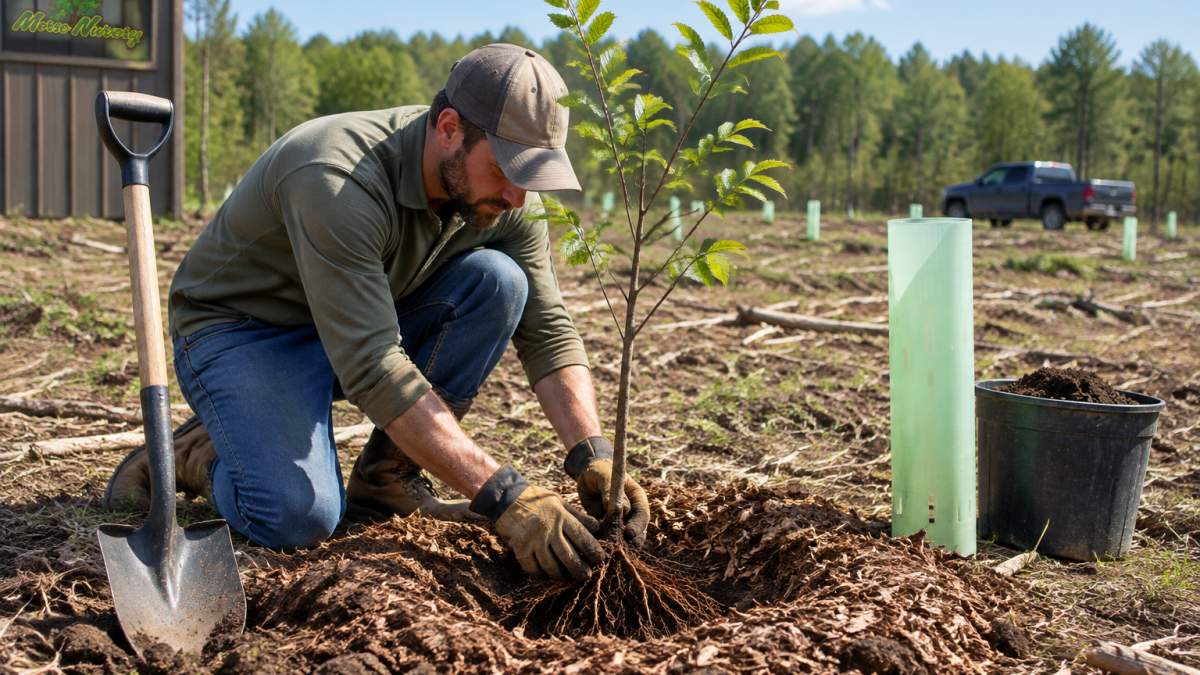
This is the step most chestnut guides skip, and it most directly speeds timber growth. Chestnuts form ectomycorrhizal associations, partnerships with soil fungi that extend the root system and improve water and nutrient uptake. On ground that has grown only grass or crops, those fungi may be scarce. Inoculating the planting hole with a commercial ectomycorrhizal product, or planting near established chestnut or oak roots, can improve first-year survival and early vigor.
Spacing Requirements for Straight, Clear Trunks
- Prepare and clear the planting rows before delivery
- Set trees at the same depth they grew in the nursery
- Use weed mats or mulch to suppress weeds and hold moisture
- Water through the first dry seasons until roots establish
Chestnut Tree Pruning for Straight Trunks and Higher Log Grade
Prune in dormancy, keep cuts clean, and favor a strong central leader over a bushy top. A tree that forks low will never produce a premium butt log no matter how fast it grows.
Protecting Your Investment From Pests, Deer, and Transplant Shock
Deer browse is the other constant. A buck will rub and nip a sapling before it ever reaches timber size, so physical protection pays for itself. We stock a Tree tubes and tree support stake to hold young trees steady against wind and keep them growing upright.

Frequently Asked Questions
How long does it take for a hybrid chestnut tree to reach timber maturity?
Most hybrid chestnuts grown for timber need at least 20 to 25 years before they produce sawtimber-grade logs, depending on site quality and genetics. Fast-growing hybrids can put on 3 to 5 feet of height per year once established, which shortens the rotation compared with slower hardwoods. Good soil, full sun, and early pruning for a single straight leader all push you toward the shorter end of that range. Plan for a long hold and thin the stand as the canopy closes.
Are hybrid chestnut trees as valuable as native American chestnut lumber?
American chestnut wood was prized for its rot resistance and straight grain, and hybrid chestnut lumber carries many of the same qualities. The timber market for hybrid chestnut is still developing, so expect to sell on the general hardwood market rather than a specialty premium at first. The practical value comes from combining a saleable log with decades of nut and mast production on the same acreage, which spreads your return across two income streams.
Can I harvest timber from hybrid chestnut trees planted mainly for wildlife?
Yes, with planning. Trees planted for mast still develop usable logs if you give them room and train a single central leader early. Thin crowded plantings so the best trunks have space to put on diameter, and prune lower branches on your crop trees to lift the clear length. You can keep a mix: some trees managed tight for nut production and a subset spaced wider and pruned for sawtimber. Decide which trees are your timber trees by year five.
Where can I buy hybrid chestnut trees with known genetics?
Morse Nursery offers the Morse Hybrid Chestnut, an American x Chinese cross rated for Zones 4 to 9 with September to October nut drop, and the August Drop American Hybrid Chestnut Tree, rated for Zones 4 to 8 with August nut drop. Our trees are air-pruned, and a one-year tree survival guarantee applies with qualifying Survival Kit purchases.