7 Oak Trees for Acorn Production That Feed Deer Fast

Last Updated: October 30, 2026
Quick Summary
The best oak trees for acorn production are hybrid oaks bred for early maturity, not wild seedlings, because selected hybrids produce acorns years sooner. Plant them 20 to 30 feet apart in full sun and protect young trunks with 4- to 5-foot tree tubes until the canopy clears the browse line.
- Hybrid oaks such as the Early Hybrid Oak drop acorns from August into September in Zones 4-8.
- Fast hybrids give first light acorn crops at years 4-5 and heavy, reliable mast by years 9-10.
- A quarter-acre plot holds roughly 15 to 25 oaks planted 20 to 30 feet apart.
- Blend about 60% early/mid-drop and 40% late-drop hybrids for acorns from August through November.
- Plant at least two compatible varieties that bloom at the same time for good acorn set.
Table of Contents
- Why Oak Trees Beat Every Other Mast Tree for Deer
- Oak Trees That Produce Acorns Quickly: The Fastest Hybrids
- Oak Tree Acorn Production by Age: What to Expect Year One to Year Ten
- How to Increase Acorn Production on Your Property
- How to Choose Oak Trees From a Nursery
- Spacing, Count, and Planting Layout for a Mast Plot
- Protecting Young Oaks From Deer Browse Until They Produce
- Building Your Acorn Bundle With Morse Nursery
- Frequently Asked Questions
Why Oak Trees Beat Every Other Mast Tree for Deer
Acorns are the single most valuable fall and winter food source on most whitetail properties. Oak trees produce them in volume, and deer will walk past almost anything else to get to a fresh white oak acorn.
Here is the difference that matters. Soft mast like persimmons and apples gets eaten fast. Acorns can hold deer on your land through the hardest part of the year.
The catch? Young oaks take years to produce. Young oaks take time to produce, so choosing well-suited genetics matters.
Below, we show you exactly how to get acorns sooner, how many trees you need, and how to protect them until they pay off.
Oak Trees That Produce Acorns Quickly: The Fastest Hybrids
The fastest acorn producers are hybrid oaks bred for early maturity, not wild seedlings dug from a fence row. Selected hybrids are bred for earlier production than many wild oaks.
Crossing two white oak species can combine fast growth with sweet acorns that deer find attractive.
Our oak varieties with earlier production:
- Early Hybrid Oak - Acorns drop from August into September. Zones 4-8.
- Bur x Gambel Early Drop Hybrid Oak - Heavy September drop.
- Morse Hybrid White Oak - Fast growth, sweet acorns, September to October drop.
You can browse the full oak lineup to compare these side by side. The Early Hybrid Oak is one of our early-maturing oak options.

Oak Tree Acorn Production by Age: What to Expect Year One to Year Ten
Acorn production follows a predictable curve, and knowing it keeps you from panicking in year three. Here is the realistic timeline for a selected hybrid oak.
| Age | What Happens | Your Job |
|---|---|---|
| Year 1 | Roots establish, top growth is slow | Water, protect, mulch |
| Years 2-3 | Strong height gain begins | Keep deer off the leader |
| Years 4-5 | First light acorn crops on fast hybrids | Watch, don't expect much |
| Years 6-8 | Real production starts | Thin competition, fertilize |
| Years 9-10 | Heavy, reliable mast | Manage for the whole stand |
Wild oaks often sit in the "first light crops" stage for a decade or more. A common mistake is judging a young tree by its first sparse crop. Acorn output climbs sharply once the crown fills out.
How to Increase Acorn Production on Your Property
More acorns come from three things: sunlight, soil, and genetics. Get those right and the tree does the rest.
- Open the canopy. Oaks need full sun. Release young trees from competing brush and shade.
- Fix the soil first. A soil test tells you what to add. Most mast plots need lime before anything else.
- Plant improved genetics. A selected hybrid outproduces a wild seedling of the same age.
- Space for crowns. Crowded trees shade each other and cut production.
- Protect the crop. Deer will browse acorns off the ground, but they also strip young trees bare.
The USDA Natural Resources Conservation Service offers soil testing guidance and local conservation support for landowners. Their advice on site preparation lines up with what we tell customers: fix the ground before you plant.
How to Choose Oak Trees From a Nursery
Choosing oak trees comes down to matching the tree to your ground and your goal. Ask four questions before you buy.
- What zone am I in? Check the USDA Plant Hardiness Zone Map so you buy trees rated for your winters.
- What is my soil? Rocky, dry ground calls for a tough hybrid. Rich loam opens up more options.
- When do I want acorns to drop? Early-season food pulls deer in during archery season. Late drop holds them through winter.
- How fast do I need production? If you can't wait a decade, buy a hybrid bred for early maturity.
Look at root systems, not just top growth. Air-pruned trees are one of the nursery's growing methods. Ask how the trees were grown and whether a survival guarantee is offered. We offer a one-year guarantee with qualifying Survival Kit purchases.
Spacing, Count, and Planting Layout for a Mast Plot
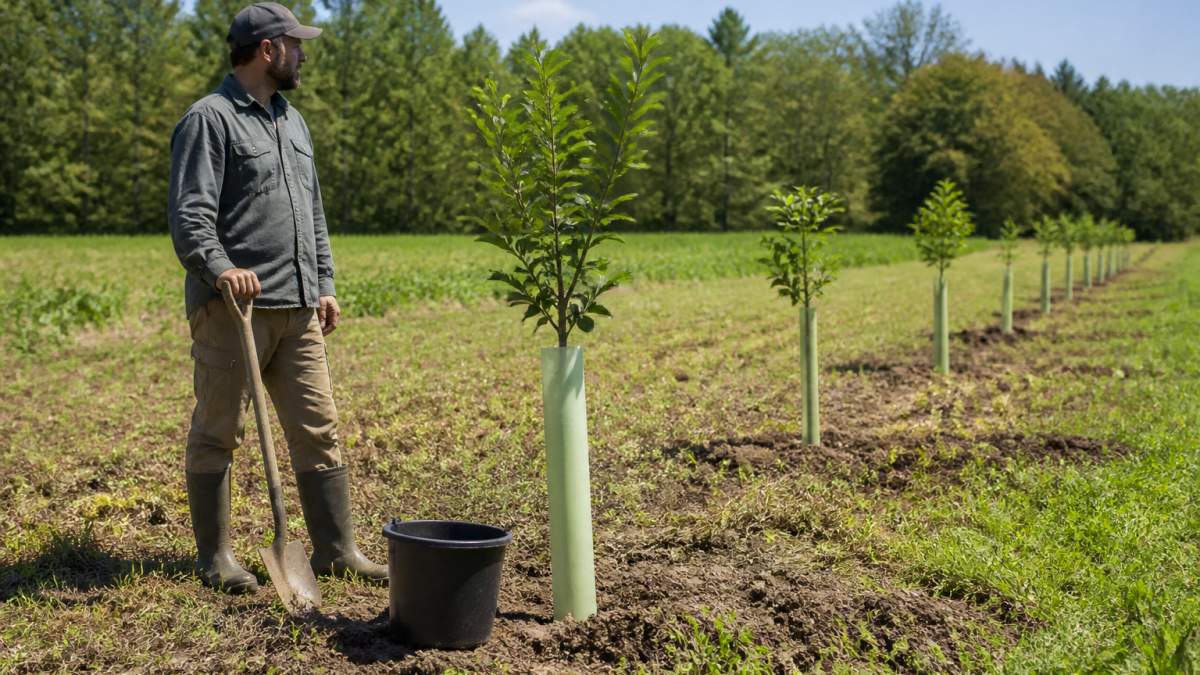
Spacing and tree count decide how much acorn tonnage your plot can carry, but the layout matters just as much. Plant oaks 20 to 30 feet apart in full sun. That gives each crown room to spread and produce. For a rough count, figure one oak per 400 to 700 square feet at that spacing. A quarter-acre plot holds roughly 15 to 25 trees.
A Complete Planting Plan for a Wildlife Plot
Most guides stop at spacing. Here is the full sequence so you can act without piecing together forum posts.
- Site prep (6-12 months ahead). Test soil, apply lime per results, and control competing vegetation with mowing or herbicide. Full sun is non-negotiable.
- Layout. Mark clusters of three to five trees on 20-30 foot centers. Leave travel lanes and edge feathering between clusters.
- Variety mix. Blend early-drop and late-drop hybrids so acorns are on the ground from August through November. A common ratio is 60% early/mid-drop and 40% late-drop.
- Planting sequence. Plant bare-root trees in late winter or early spring while dormant. Dig holes wide enough for air-pruned roots, set the root collar at grade, backfill, and water in.
- Protection at planting. Install 4- to 5-foot tree tubes and stakes the same day. Add wire cages where deer pressure is heavy.
- First-year care. Water during dry spells, keep tubes clear of debris, and mow between rows to reduce competition.
Ready-to-Buy Bundles by Plot Size
If you want a ready-made count, the Oak Habitat Bundle 18 36 10 Trees Kits fits a smaller plot of roughly a quarter acre. For a bigger planting, step up to the Oak Habitat Bundle 36 60 10 Tree Kits to match your acreage. These bundles already include a mix of early- and late-drop hybrids, so you get a staggered food window without ordering individual trees.
Pollination and Bloom Overlap
Oaks are wind-pollinated, but not every hybrid is a reliable partner. Plant at least two compatible varieties that bloom at the same time to ensure good acorn set. A common pattern is to pair a early-blooming white oak hybrid with a mid-bloom hybrid so pollen is available when female flowers are receptive. If you are planting a small plot, choose varieties known to self-pollinate or confirm compatibility with the nursery before you buy.
Matching Bundles to Your Site
Zone ratings get you close, but soil and drainage decide the rest. Rocky, dry ground calls for a tough hybrid; rich loam opens up more options. If your site holds water in spring, plant on raised mounds or choose a hybrid rated for heavier soils. Adapt any bundle by swapping one variety for another that matches your conditions, the nursery consultation can help you make that swap without losing the drop-window mix.
Protecting Young Oaks From Deer Browse Until They Produce
Deer can wipe out a young oak planting in a single winter. Browse is the number one reason new trees fail, and it is entirely preventable. The key is matching the protection method to your deer pressure and maintenance schedule.
Protection Options Compared
| Method | Best For | Pros | Cons | Maintenance |
|---|---|---|---|---|
| Tree tube (4-5 ft) | Moderate pressure, fast growth | Shields leader, pushes vertical growth, moderate cost | Can trap debris, needs staking | Monthly checks in year one |
| Wire cage (4-6 ft) | Heavy pressure, buck rub | Stops browse and rub, reusable | Higher upfront cost, can snag weeds | Seasonal weed control |
| Tube + cage combo | Very heavy pressure | Maximum protection | Most expensive, most labor | Monthly checks |
| Fencing (plot-level) | Large plantings | Protects many trees at once | Highest cost, permanent | Fence repair |
A Practical Timeline
- At planting: Install a 4- to 5-foot tree tube and stake. Add a wire cage where buck rub is likely.
- Year one: Check tubes monthly. Clear weeds and debris from the top. Water during dry spells.
- Years two to three: Keep tubes on. The leader is still within browse range.
- Years four to six: Leave protection on until the canopy clears the browse line, usually 4 to 6 feet of trunk. A tree that looks tall enough can still get nipped back to the ground.
Materials and Cost Considerations
Plot-level fencing is the highest-cost option but protects many trees at once. Choose based on deer pressure and how much time you can spend on maintenance. The Penn State Extension publishes practical guidance on tree tubes and seedling survival that matches what we see in the field.
Building Your Acorn Bundle With Morse Nursery
A good acorn bundle is built around your goal, not a random mix of trees. Start with your zone, your soil, and the drop window you want. Then pick hybrids that overlap in bloom and ripen at different times.
Morse Nursery is a family-owned nursery with over 40 years of forestry and wildlife habitat expertise. Our experts have helped over 1,000 customers design custom habitat plans. We offer a free nursery consultation to map out your planting.
You can see the white-tail tree collection to assemble a bundle that fits your property.
Frequently Asked Questions
Which oak trees produce acorns the fastest?
Hybrid oaks bred from fast-maturing white oak parents are the quickest to bear. Morse Nursery's Bur x Gambel Early Drop Hybrid Oak can reach acorn production in as little as 3 to 8 years, and the Early Hybrid Oak starts in 5 to 8 years. Match the tree to your USDA hardiness zone and give it full sun and good drainage to hit those timelines.
How long does it take an oak tree to produce acorns?
Oak tree acorn production by age varies widely by species and genetics. Wild red and white oaks commonly take 10 to 20 years before a meaningful crop. Genetically selected hybrids from Morse Nursery are bred for earlier production than many wild oaks. Soil quality, sun exposure, and early weed control all affect how close you get to the fast end of that range.
Do oak trees need another oak tree to produce acorns?
Yes for most oaks. Most oak species are wind-pollinated and self-incompatible, so they need a compatible oak nearby that blooms at the same time to set a good acorn crop. Plant at least two varieties with overlapping bloom windows, or two seedlings of the same hybrid, within 50 to 100 feet of each other. A lone oak will often produce some acorns, but a small group produces far more.
How can I increase acorn production on established oaks?
Focus on light, water, and competition. Thin competing trees so each oak crown gets full sun, which drives flower and acorn set. Control weeds and grass around young trees for the first two to three years, and water during dry spells in the first two seasons. On older trees, avoid heavy pruning in spring and keep the root zone free of compaction and equipment traffic. Healthy crowns produce more mast.
The hardest part of growing acorns isn't planting. It's waiting while deer pressure and dry spells test your patience. The right genetics and the right protection shorten that wait and protect your investment. Morse Nursery pairs selected hybrid oaks with air-pruned roots, expert planting consults, and a one-year survival guarantee with a qualifying Survival Kit. Get started with Morse Nursery and build an acorn stand that feeds deer for decades.